The $12,000 Mistake: Why Account Priority Matters

Written by
Divya MoreauMBA, Financial Educator
Divya is an MBA graduate and financial educator based in Calgary with a passion for helping Canadian families build wealth through disciplined saving and smart investing. She specializes in mortgage planning, real estate analysis, retirement projections, and first-home buyer strategies.
AI Generated by TrackMoola
The $12,000 Mistake: Why Account Priority Matters
Marcus's situation in 2023:
- Age 32, earning $85,000/year in Toronto
- First-time home buyer, planning to buy in 3 years
- Two kids (ages 3 and 5)
- Had $15,000 to invest that year
He put it all in his RRSP. It seemed like the safe choice.
The problem: Marcus left $12,000 in government benefits on the table.
What Marcus Should Have Done
Using the optimal account priority strategy, here's how Marcus should have allocated his $15,000:
Priority 1: FHSA - $8,000
Why first?
- Tax deduction like RRSP: $8,000 × 31% = $2,480 tax savings
- Tax-free growth like TFSA
- Tax-free withdrawal for home purchase
- Best of both worlds for first-time buyers
Marcus's benefit: $2,480 in tax savings + tax-free growth
Priority 2: RESP - $5,000
Why second?
- 20% CESG grant: $5,000 × 20% = $1,000 free money
- Two kids = $2,500 each for maximum grant
- Kids are young (ages 3 and 5) = 15+ years of grants remaining
- Time-sensitive benefit (grants stop at age 17)
Marcus's benefit: $1,000 in CESG grants
Priority 3: RRSP - $2,000
Why third?
- Tax deduction: $2,000 × 31% = $620 tax savings
- Good for retirement savings at his income level
Marcus's benefit: $620 in tax savings
Total Benefits: $4,100
- FHSA tax savings: $2,480
- RESP grants: $1,000
- RRSP tax savings: $620
What Marcus Actually Did
Marcus put all $15,000 in his RRSP.
His benefit: $15,000 × 31% = $4,650 in tax savings
Sounds good, right?
But here's what he missed:
The Lost Benefits
Year 1 (2023):
- Lost FHSA room: $8,000 (can't carry forward)
- Lost RESP grants: $1,000 (can't get back)
- Total lost: $9,000 in benefits
Over 3 years (until home purchase):
- Lost FHSA room: $24,000
- Lost RESP grants: $3,000
- Total lost: $27,000 in benefits
Marcus realized his mistake in 2024 when his friend mentioned the FHSA. By then, he'd already lost $8,000 in FHSA room (it doesn't carry forward year-to-year).
The Complete Priority Framework
Here's the optimal order for most Canadians:
Tier 1: Government Matching (Highest Priority)
1. RDSP (if DTC eligible)
- Up to 350% government match
- $1,000 contribution → $4,500 total benefit
- Only available until age 49
2. FHSA (if first-time buyer)
- Tax deduction + tax-free growth + tax-free withdrawal
- $8,000/year limit
- Must use within 15 years
3. RESP (if children under 18)
- 20% CESG grant ($500/year per child)
- Prioritize younger children (more grant years)
- $2,500/year per child for maximum grant
Tier 2: Tax-Advantaged Accounts (Income-Based)
4a. RRSP (if income >$60,000)
- Tax deduction at your marginal rate
- Good for high earners
4b. TFSA (if income <$60,000)
- Tax-free growth
- Withdrawals don't affect GIS/OAS in retirement
- Better for low earners
Tier 3: Taxable Accounts
5. Non-Registered
- No limits, but gains are taxable
- Use after maxing all tax-advantaged accounts
Real-World Scenarios
Scenario 1: Young Family, First-Time Buyer
Profile:
- Age 30, income $75,000
- First-time buyer, buying in 4 years
- Two kids (ages 2 and 4)
- $20,000 to invest
Optimal allocation:
- FHSA: $8,000
- RESP: $5,000 ($2,500 × 2 kids)
- RRSP: $7,000
Benefits: $3,400 tax savings + $1,000 CESG = $4,400
Scenario 2: Person with Disability, Low Income
Profile:
- Age 28, income $35,000
- DTC eligible
- No children
- $3,000 to invest
Optimal allocation:
- RDSP: $1,000
- TFSA: $2,000
Benefits: $3,500 CDSG + $1,000 CDSB = $4,500 in grants
Scenario 3: High Earner with Older Kids
Profile:
- Age 45, income $150,000
- Two kids (ages 14 and 16)
- $30,000 to invest
Optimal allocation:
- RESP: $5,000 ($2,500 × 2 kids) - limited time left!
- RRSP: $25,000
Benefits: $1,000 CESG + $9,000 RRSP tax savings = $10,000
The RESP comes first despite high income because the kids are older. In 2-4 years, CESG eligibility ends forever.
Scenario 4: All Accounts - The Jackpot
Profile:
- Age 33, income $85,000
- First-time buyer, buying in 5 years
- One child (age 3)
- DTC eligible
- $25,000 to invest
Optimal allocation:
- RDSP: $1,000 (350% match)
- FHSA: $8,000 (tax deduction + tax-free)
- RESP: $2,500 (20% CESG)
- RRSP: $13,500 (tax deduction)
Benefits:
- RDSP grants: $4,500
- FHSA tax savings: $2,550
- RESP grants: $500
- RRSP tax savings: $4,300
- Total: $11,850 in benefits
That's a 47% return before any investment growth!
How to Determine Your Priority
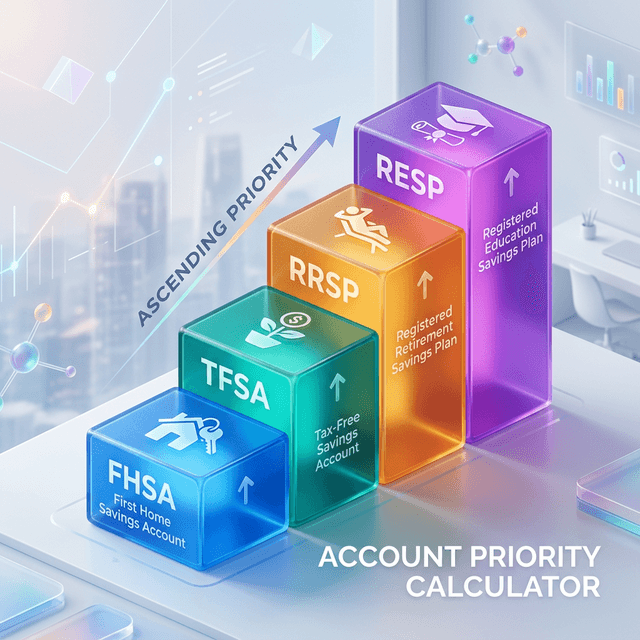
Use our Account Priority Calculator to get personalized recommendations based on:
- Your income and province
- Your age
- First-time buyer status
- Children's ages
- Disability status
- Current account balances
The calculator will show you:
- Exact priority order
- Suggested amount for each account
- Total tax savings and grants
- Available contribution room
The Time-Sensitive Accounts
Some accounts have deadlines that make them higher priority:
RDSP: Grants end at age 49
- If you're 45 with DTC, you have 4 years left
- That's $18,000 in grants you'll never get back
RESP: Grants end when child turns 17
- If your child is 15, you have 2 years left
- That's $1,000 in grants you'll never get back
FHSA: Must use within 15 years of opening
- Room doesn't carry forward year-to-year
- If you're buying soon, prioritize it
Marcus's Redemption Story
After learning about account priority, Marcus fixed his strategy for 2024:
2024 allocation ($18,000):
- FHSA: $8,000
- RESP: $5,000
- RRSP: $5,000
2025 allocation ($20,000):
- FHSA: $8,000
- RESP: $5,000
- RRSP: $7,000
2026 allocation ($22,000):
- FHSA: $8,000 (now at $24,000 total)
- RESP: $5,000
- TFSA: $9,000
By 2026, Marcus had:
- FHSA: $24,000 + growth (ready for home down payment)
- RESP: $15,000 + $3,000 CESG + growth
- RRSP: $12,000 + growth
- TFSA: $9,000 + growth
He recovered most of the lost RESP grants and maximized his FHSA for the home purchase.
Your Action Plan
Step 1: Identify which accounts you're eligible for
- RDSP: Do you have DTC?
- FHSA: Are you a first-time buyer?
- RESP: Do you have kids under 18?
Step 2: Calculate your optimal priority
- Use our Account Priority Calculator
- Input your income, age, and situation
- Get personalized recommendations
Step 3: Set up automatic contributions
- Allocate funds to accounts in priority order
- Set up monthly automatic transfers
- Review annually as your situation changes
Step 4: Don't leave money on the table
- Capture time-sensitive benefits first (RDSP, RESP, FHSA)
- Then optimize for tax efficiency (RRSP vs TFSA)
- Finally use non-registered accounts
Key Takeaways
✅ Priority matters - wrong order costs thousands in lost benefits
✅ Government matching first - RDSP and RESP are free money
✅ Time-sensitive accounts next - FHSA room doesn't carry forward
✅ Then tax efficiency - RRSP vs TFSA based on income
✅ Review annually - priorities change as life changes
✅ Use the calculator - personalized recommendations beat generic advice
Disclaimer: Account limits and contribution room are estimates. Tax benefits depend on your specific situation. Always verify with the CRA and consult a licensed financial advisor before making investment decisions.
Ready to optimize your account strategy? Try our Account Priority Calculator to see your personalized priority order.