Renting vs Buying in Canada 2026 — What the Numbers Actually Show
A numbers-driven analysis of renting vs buying in Canada. Factor in true costs of ownership, opportunity cost, break-even horizons, and GDS/TDS affordability ratios.
Estimated time: 10-15 minutes
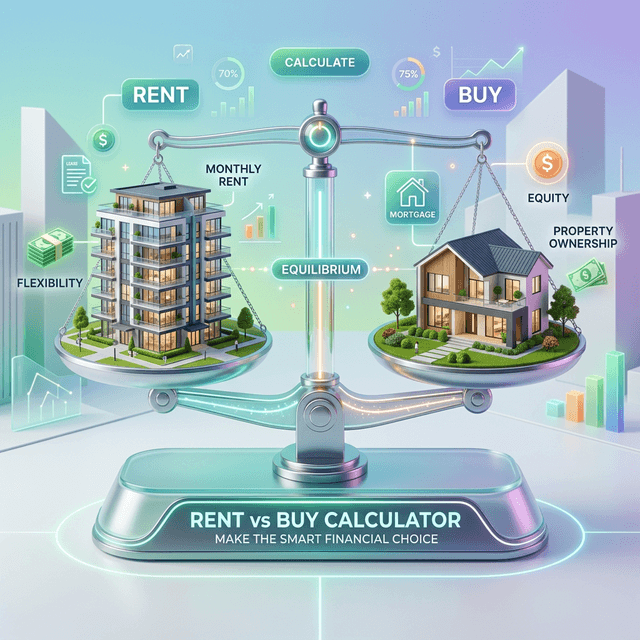
AI Generated by TrackMoola
Enter Your Current Monthly Rent
Type in your current monthly rent. This is your baseline — the calculator compares all ownership costs against this number. Use your actual rent, including parking or storage if bundled.
Enter the Home Purchase Price
Enter the asking price of the home you're considering. If you're not looking at a specific property, use the median price in your city as a starting point.
Set Your Down Payment Percentage
Enter your down payment as a percentage of the purchase price. The minimum in Canada is 5% for homes under $500,000, and 10% on the portion between $500,000–$999,999. A 20% down payment avoids CMHC mortgage insurance, which can add thousands to your mortgage.
Enter the Mortgage Interest Rate
Use a current 5-year fixed mortgage rate from your bank or a rate comparison site. As of early 2026, rates are approximately 4.5–5.5% for insured mortgages. The calculator uses Canadian semi-annual compounding, which is the legally required method for Canadian mortgages.
Enter Your Annual Household Income
This is used to calculate your GDS (Gross Debt Service) and TDS (Total Debt Service) ratios — the two key affordability checks lenders use. GDS must be ≤39% and TDS must be ≤44% to qualify for a standard mortgage.
Select Your Province
Your province determines land transfer tax (LTT), which is a one-time cost when buying. Ontario, BC, and Quebec all have different LTT rates. First-time buyers in Ontario get a rebate on the first $4,000 of LTT.
Set Rent Increase and Appreciation Rates
The default 2% rent increase and 3% home appreciation reflect long-run Canadian averages. If you're in a hot market, you might increase appreciation. If rents are rent-controlled, keep the rent increase at 2.5% (Ontario's 2024 guideline).
Set the Investment Return Rate
This is what the renter earns by investing the down payment instead of spending it. A 6% annual return is a reasonable long-run average for a balanced portfolio. Lower it to 4-5% to be conservative.
Read the Winner Result
The calculator shows which option wins at 5 and 10 years. Look especially at the break-even year — this is how long you'd need to own the home before buying becomes financially superior to renting.
Review the Affordability Check
If your GDS ratio exceeds 39% or TDS exceeds 44%, lenders may not approve your mortgage at the stated price. This is a signal to consider a lower-priced home or a larger down payment.
Share Your Results
Use the Share button to send your results to a partner, parent, or mortgage broker. The link is valid for 7 days and shows your exact inputs so others can verify or tweak the assumptions.